


On 11 March 2020 the World Health Organization declared a pandemic. Within days, normal life was suspended across much of the world. Emergency laws were rushed through parliaments, fear-based messaging saturated the media, and new digital tools of surveillance and exclusion appeared almost overnight. In a conversation with Mary Holland, president of Children’s Health Defense, I discussed why I came to see that date 3/11 as a civilizational turning point, and why I spent more than five years of investigation, much of it spent writing 3/11 Viral Takeover.
My background is not conventional journalism. I previously worked as a researcher on BBC documentaries and trained in economics. When the pandemic was declared I began conducting evidence-based investigations because the mainstream outlets I had once worked alongside were not asking the obvious questions.
A biological sequel to 9/11
The framing of the book is deliberate. I view 3/11 as a biological sequel to 9/11. Both were disruptive events that produced widespread fear and were followed by significant expansions of state power. After 2001 we saw the Patriot Act and a permanent architecture of surveillance. After 2020 we saw the Coronavirus Act (and its equivalents elsewhere), emergency powers that transferred decision-making to unelected officials, and a new willingness by large sections of the public to comply with unprecedented restrictions. The first two chapters of the book examine the early emails among Anthony Fauci, Francis Collins, Jeremy Farrar and others, alongside the behavioural-science discussions in which officials openly discussed the need to “amp up fear,” use social disapproval, and rely on media to heighten the sense of threat.
The same pattern appears in the pre-pandemic planning. Event 201, the October 2019 tabletop exercise, produced recommendations that public and private sectors should work together to combat “misinformation,” with governments coordinating with social-media companies. Those recommendations became operational within weeks of the pandemic declaration. The Trusted News Initiative, led by the BBC and linking legacy media, big tech and government, began suppressing dissenting voices in real time. Parallel efforts, including the Center for Countering Digital Hate’s influence on the UK’s Online Safety Act and the EU’s Digital Services Act, codified the approach. What began as emergency measures to manage a novel virus has hardened into standing infrastructure for narrative control.
What the documents revealed
One of the most disturbing parts of my research was the safety information that was available before, or shortly after, the gene-based COVID shots were rolled out. The FDA’s October 2020 slide listing potential adverse events of special interest is now well known; less widely examined are the Periodic Safety Update Reports BioNTech submitted to the European Medicines Agency. Those reports contain documented cases of children dying after the shots. The data were waved through by regulators while the products were extended to younger age groups.
Parallel Freedom of Information work in the UK revealed another layer. NATO had been involved in aspects of the UK’s COVID response in countering “misinformation.” The relevant department admitted the involvement but refused to release the documents on national-security grounds. NATO’s own published material on “inoculation theory” (pre-empting dissent through online games developed with Cambridge University, the UK Parliament and the WHO) shows how psychological operations were integrated into the public-health response.
Accountability and the permanent infrastructure
The UK COVID Inquiry is the most expensive public inquiry in British history. On the surface it appears to offer accountability. In practice it has functioned largely as a whitewashing exercise. The same behavioural scientists who designed the fear-based messaging appear as experts; mathematical models that proved wildly inaccurate are treated as reasonable bases for policy; and vaccine-injured individuals are acknowledged only as a small minority. Compensation remains capped and difficult to obtain. Meanwhile, the temporary vaccine-passport system has evolved into permanent digital-identity infrastructure. UN Sustainable Development Goal 16.9 calls for universal legal identity by 2030. Real-time facial-recognition cameras are already used by UK police. Arrests for social-media posts deemed to “incite hatred” or spread “misinformation” now average dozens per day. The Online Safety Act and the Digital Services Act give the framework statutory force.
The trajectory is toward digital authoritarianism: AI-powered tracking of purchases, movement and communications, combined with the ability to restrict access to ordinary activities. China supplied both the lockdown model and much of the surveillance equipment now being adopted in Western cities. The result is not a temporary public-health measure but a new operating system for governance. One that treats compliance as the default and dissent as a security problem.
What began as temporary emergency measures has been converted into permanent systems of surveillance, censorship and digital control. The question is no longer whether 3/11 changed the world. It is whether we will allow the architecture built in its name to remain in place. 3/11 Viral Takeover is the documented record of how that architecture was built.
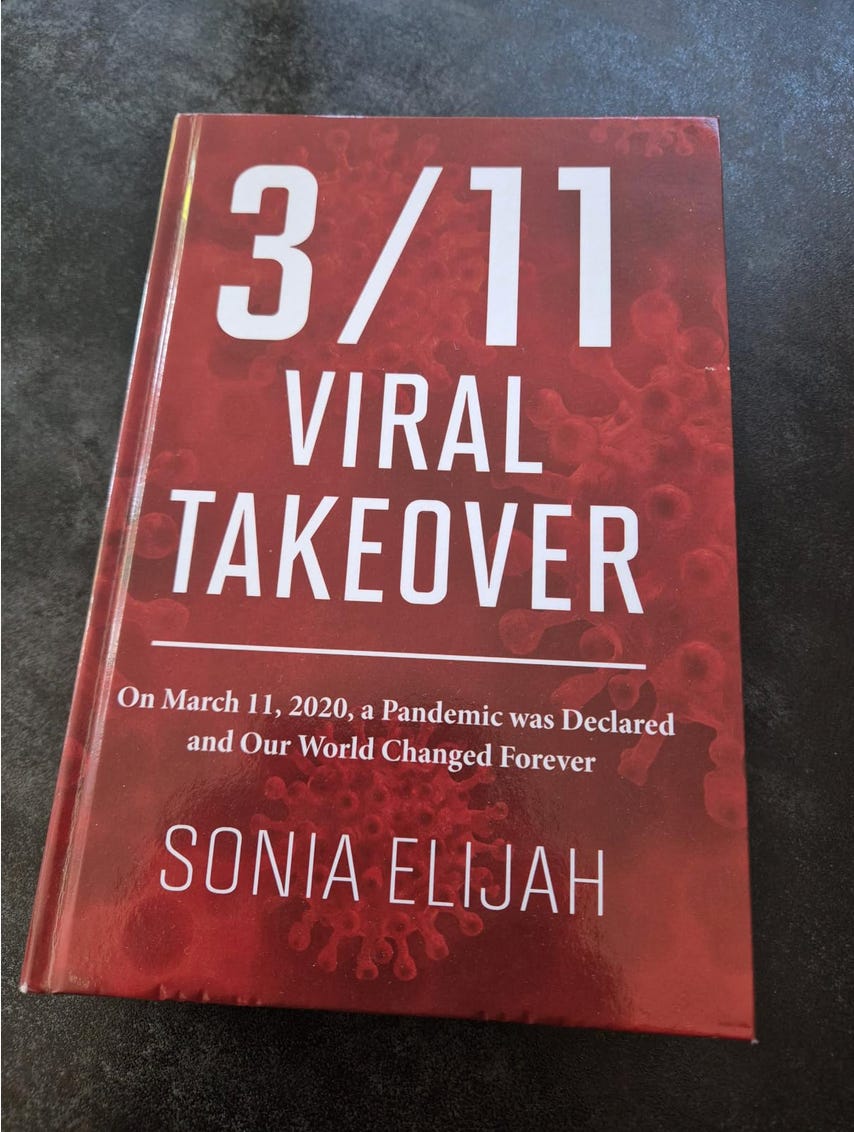
Now available in Kindle, paperback, hardcover, and audiobook!


