


In my recent interview with research pharmacologist and medical product regulatory expert Dr. David Wiseman(PhD, MRPharmS), we dissect the evidence from Senator Ron Johnson’s Permanent Subcommittee on Investigations report, Unmasked: How Biden Health Officials Purposely Turned a Blind Eye Toward COVID-19 Vaccine Safety Signals. The April 2026 report, released with hundreds of pages of records, shows how FDA officials were repeatedly warned in early 2021 by Dr. Ana Szarfman (a senior medical officer in the agency’s Center for Drug Evaluation and Research) that their main method for detecting COVID vaccine safety signals in VAERS was disabled by a statistical problem called masking, which hides unexpected patterns of adverse events, and that a better method already existed. Rather than adopt the fix, senior officials directed the FDA doctor who brought it forward to “cease and desist.”
The result, as the records show, was a deliberate failure to investigate potential safety signals the agency was legally required to consider, leaving the US vaccine early-warning system not fit for purpose.
Wiseman, a highly prominent public figure regarding the scrutiny of FDA safety monitoring data, wrote a September 2025 preprint that estimated the scale of statistical signals lost to masking. He later testified at Senator Ron Johnson’s April 29, 2026 hearing and, in this interview, walks through the internal FDA emails, the technical failures, and what they mean for the surveillance system going forward.
A statistical signal is not proof that a vaccine caused an injury. As Wiseman puts it:
“The signal does not prove causation. Let’s be really clear about that. It’s a signal that says, here’s your engine warning light. Go check your engine. It doesn’t prove that there’s a problem with your engine. It just says, OK, you better check this out.”
The failure was not generating or acting on those warning lights.
Masking and the High Threshold
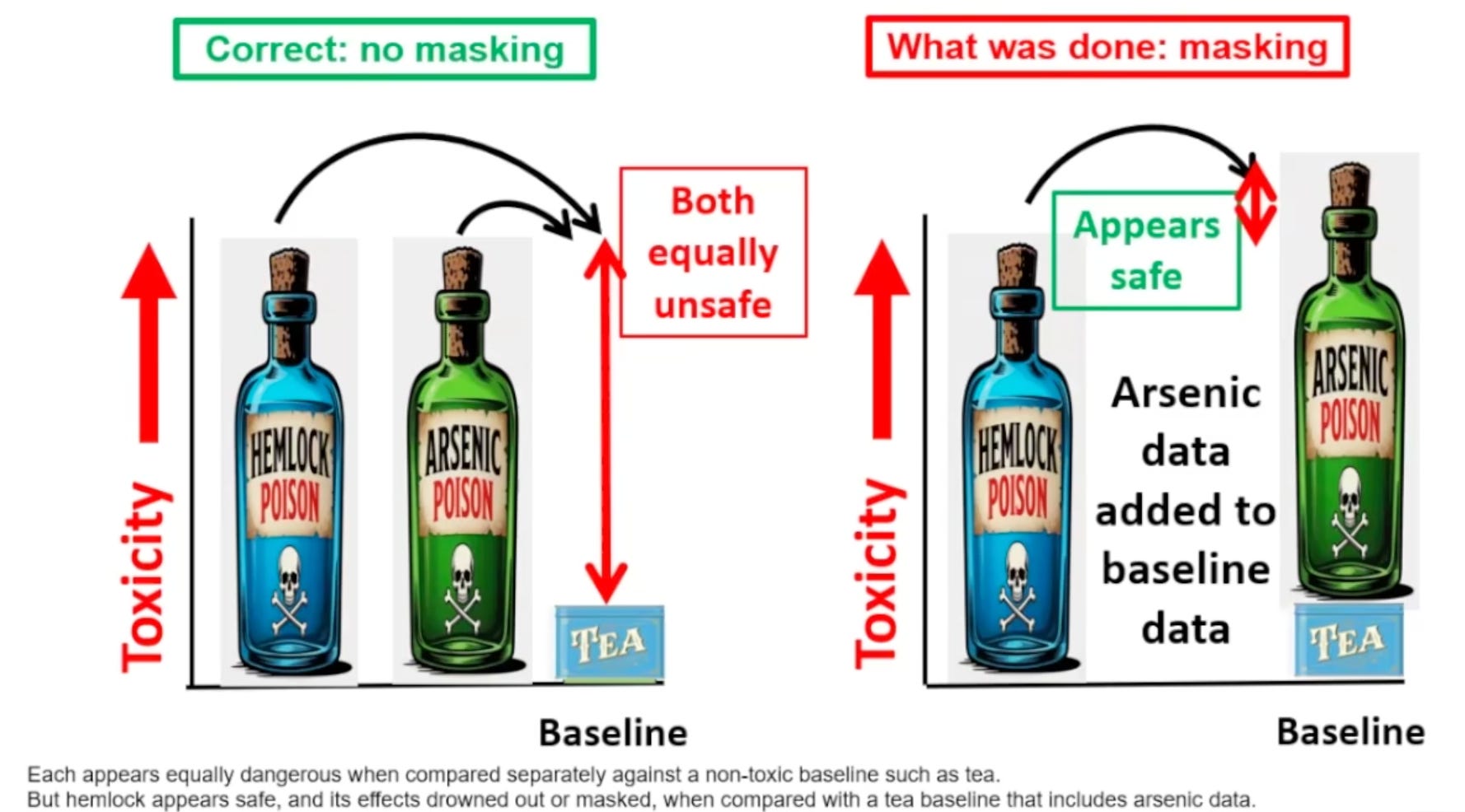
Masking occurs when the comparison group used to decide whether an adverse event is disproportionate already contains a large volume of the same type of reports from other products. In the early COVID-vaccine rollout, more than 90 percent of VAERS reports were for the mRNA shots. Comparing Pfizer to “everything else” therefore included Moderna reports (and vice versa). If both products elevated the same risk, the observed and expected frequencies looked similar and no alert was generated.
Wiseman uses a simple illustration. Picture two equally toxic substances, hemlock and arsenic, each compared against a safe baseline such as tea. Both stand out as unsafe. Now mix arsenic into the baseline data. Hemlock no longer looks elevated relative to that inflated baseline, even though it is just as toxic. This is masking.
A second, related problem was the detection threshold itself. The agencies typically required the lower bound of the confidence interval to exceed 2 before counting a signal, rather than treating values statistically greater than 1 as worth examining. Wiseman argues that this choice was especially inappropriate for a new technology authorised under emergency conditions:
“That’s not a time to be setting the threshold at two. You need to be looking at everything. And so what? You get a few false positives, but you don’t want to get false negatives.”
Myocarditis: The Signal the Standard Method Missed
Myocarditis became one of the most visible examples of the masking problem. The standard empirical Bayesian method used by the FDA failed to generate a signal for myocarditis (or pericarditis) associated with the mRNA vaccines, even as case reports mounted and later analyses confirmed elevated rates, particularly in young males. This was because both Pfizer and Moderna produced large numbers of similar cardiac reports, each effectively inflated the baseline against which the other was measured. The result was no automated alert.
FDA officials including then-Center for Biologics Evaluation and Research (CBER) Director Peter Marks repeatedly told the public and COVID vaccine injured individuals that no signals were being seen. Wiseman calls that position untenable once the internal analyses are examined:
“Marks is telling.. we don’t see a signal yet. We believe you, but we don’t see a signal yet. I mean, this is absolutely outrageous.”
The Inventors of the Method Identified the Flaw
The empirical Bayesian method and the software the FDA used were developed by the pioneering statistician, computer scientist and data analyst Dr. William DuMouchel. Dr. Ana Szarfman, then a senior medical officer in the FDA’s CDER, had been the internal champion who helped bring the system into the agency.
In a 2022 Drug Safety paper, Harpaz, DuMouchel, Szarfman, and colleagues quantified masking in COVID-vaccine data and showed that an adjusted approach could recover signals the standard method missed. The paper examined seven adverse events (Bell’s palsy, myocarditis, pericarditis, appendicitis, pulmonary embolism, herpes zoster, and tinnitus) and demonstrated that signals for them could be undetected or delayed under the standard methods then in use.
Wiseman highlights the significance of who was raising the alarm:
“This is the father of the method, William DuMouchel, as it were, and the mother, as it were, Anna Szarfman. And that’s who’s writing this paper. That is about as significant as it gets.”
Internal records show Szarfman presented the problem and the alternative method to Peter Marks and other senior officials at the FDA in early March 2021. Subsequent analyses she shared identified roughly 25 statistically significant signals the standard method had not flagged, including sudden cardiac death, Bell’s palsy, pulmonary infarction, acute myocardial infarction, and death or sudden death. The response was not adoption. In May 2021 she was told to hold off on creating and sending further data-mining results; in September Marks wrote that she had been asked to “cease and desist” because the approach could create conflicts that fed “anti-vaccination rhetoric.”
Hundreds of Signals Missing
Using the FOIA-released weekly tables, the Harpaz paper’s supplemental data, and other datasets, Wiseman estimated the combined effect of missing reports, masking, and the elevated threshold. The central figure he arrived at was substantial:
“The sort of central number that I came up with was about 760 missing events.”
The practical outcome was that the mRNA products generated almost no automated alerts for many events later flagged by other methods, while the system continued to register numerous Janssen signals.
Those missing signals were not optional details. Under the statutory standard for Emergency Use Authorization, the FDA is required to consider known and potential risks (even without proof of causation) when determining whether the known and potential benefits outweigh the risks. Statistical safety signals are precisely the kind of potential risk the agency is legally obliged to examine. Wiseman is blunt about what happened instead. Speaking about the failure to properly process and investigate the signals that were appearing, he said:
“They were legally required to do that. They didn’t do it. That’s the scandal.”
The Early Warning System Is Now Impaired for Every Vaccine
Since the volume and variety of COVID-vaccine reports now sit inside VAERS, the same masking problem affects signal detection for other products. Rare or novel events that appear even at low levels from the COVID shots raise the baseline against which a different vaccine is judged. Wiseman’s conclusion is direct:
“When I say that VAERS is disabled, because it’s not only disabled for the COVID vaccines, it’s disabled for everything.”
The early-warning function the agencies have long described as the nation’s pharmacovigilance system is therefore compromised going forward.
The BMJ Investigation and Missing Credit
A BMJ investigation, published 16 September 2026, later covered elements of the same story, including interviews with Szarfman and DuMouchel. It confirmed that officials knew of the algorithm’s limitations and that Szarfman had been told to stop. Yet the piece does not cite Wiseman’s September 2025 preprint quantifying the lost signals, nor does it name Senator Ron Johnson or the Permanent Subcommittee on Investigations report and hearing that assembled and released the core documentary record months earlier. Wiseman observed that the BMJ presentation gave the impression of an original investigation into findings that the Senate investigators and independent analysts had already documented and made public. The journalistic contribution expanded visibility and added some interviews, but the quantitative estimates of signal loss and the primary-source timeline remain grounded in the work that preceded it.
Senator Ron Johnson’s report and the supporting records are public. Wiseman’s preprint is available on ResearchGate. The technical details are dense, but the sequence is clear: the people who built and championed the method identified the problem early, demonstrated that a correction recovered signals for serious events, but were instructed by the FDA to stop based on the grounds that it would spread anti-vaccine sentiment.
However, the bigger scandal is that the nation’s early-warning system for vaccine safety has been effectively disabled, not just for the COVID products, but for every other vaccine going forward and nothing is being done to fix it.
This should be headline news everywhere.
If this investigative reporting matters to you, please consider a paid subscription or buy me a coffee! Your support makes this work possible.


