

Greek Courts Deliver Landmark Justice: State Held Liable for COVID Shot Harms

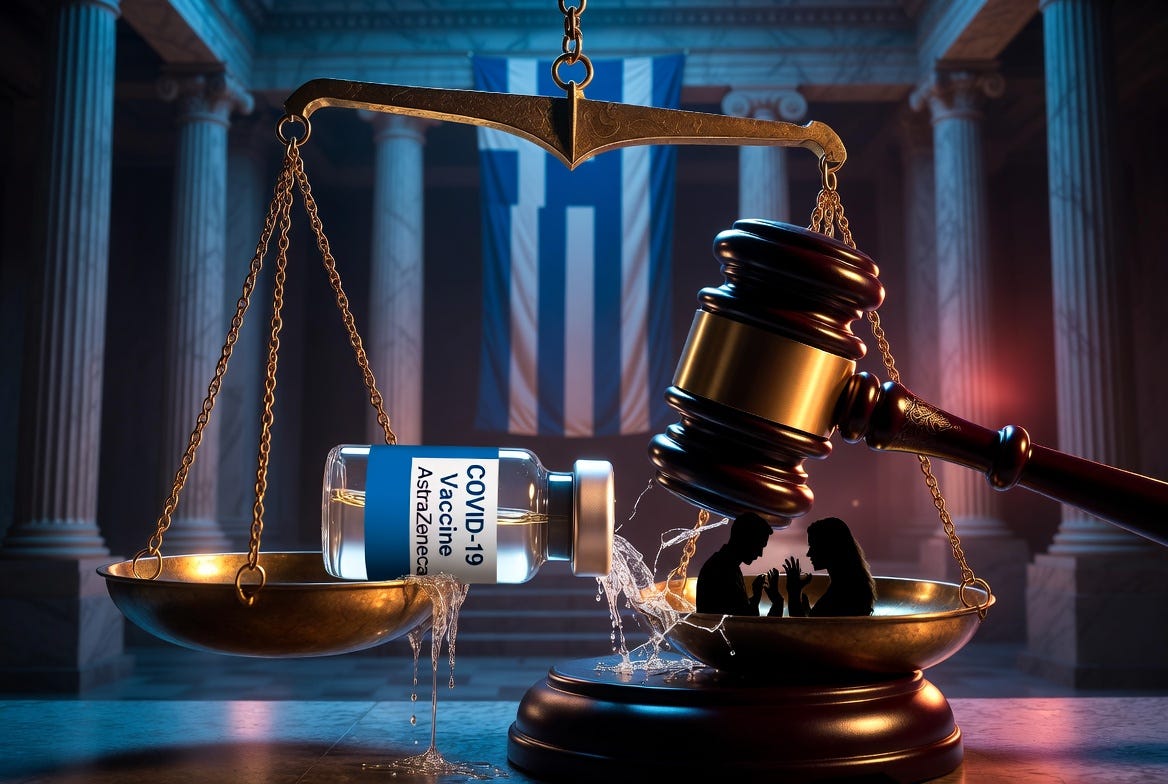
In a seismic ruling that mainstream media has largely ignored, Greek administrative courts have begun holding the Hellenic Republic accountable for serious injuries and deaths caused by COVID-19 vaccines, particularly AstraZeneca’s viral vector shot. These decisions pierce the veil of impunity that has shielded governments and pharmaceutical giants across the West.
For years, official narratives insisted the COVID-19 vaccines were “safe and effective,” with serious harms casually dismissed as rare, coincidental, or unworthy of meaningful redress. Yet in Greece, courts are applying constitutional principles of equality and social solidarity to affirm a powerful truth: when the state orchestrates a mass inoculation campaign, it assumes responsibility for the devastating burdens placed on some citizens. This is genuine no-fault accountability rooted in justice, not the pharma-friendly no-fault schemes seen in the UK, US and Australia that routinely deliver pennies on the pound while shielding manufacturers.
The €300,000 Precedent: A Thrombosis Death and State Liability
On 17 April 2026, the Administrative Court of First Instance of Athens ordered the Greek State to pay €300,000 in total compensation to the family of a woman who died from a thrombotic episode, specifically thrombosis with thrombocytopenia syndrome (TTS), following AstraZeneca vaccination. The breakdown: €120,000 to her husband and €90,000 to each of two daughters.
The court established a direct causal link with high probability: close temporal proximity, absence of other risk factors, supporting medical evidence, and peer-reviewed literature on this known rare side effect. AstraZeneca itself had admitted in UK court filings that its vaccine “can, in very rare cases, cause TTS.”
Crucially, the judges rejected the government’s defence that vaccination was “voluntary.” They recognised the totality of pressures, including mandates for over-60s with fines, healthcare worker requirements, and vaccine passports restricting daily life, which rendered participation effectively coercive in practice. The harm was deemed an “excessive sacrifice” for the collective good, violating constitutional equality (Article 4) and the principle that public burdens must be shared, not disproportionately inflicted on individuals.
Regional authorities escaped liability for merely following central directives, and AstraZeneca was cleared because no “product defect” was proven in this specific case. The State, as the orchestrator and promoter of the campaign, bore the responsibility.
Earlier Victory: €50,000 for Serious Side Effects
This builds on a 2025 ruling, where the same court awarded €50,000 in moral damages to a 40-year-old man who suffered thrombosis and Acute Disseminated Encephalomyelitis (ADEM) post-AstraZeneca. Causation was deemed “probable” via temporal link, Yellow Card-style reports, and WHO criteria. The plaintiff sought far more, but the award affirmed the State’s constitutional duty.
These cases rest on a 2021 Council of State precedent, which established that serious side effects from state-sponsored vaccines trigger compensation obligations, even without proof of negligence or defect.
International Echoes: Other Courts Holding States Accountable
Greece is not alone. In Germany, the Federal Court of Justice ruled that liability for vaccine injuries under public programmes rests with the state, not individual doctors. In South Korea, courts have ordered compensation in multiple cases, including a fatal brain haemorrhage linked to vaccination. In India, the Supreme Court has directed the government to establish a proper no-fault compensation policy for serious adverse events.
In the UK, however, courts have stopped short of holding the State directly liable. Dozens of families are pursuing product liability claims against AstraZeneca in the High Court, where the company has admitted its vaccine can cause TTS in “rare cases.” Yet here lies the elephant in the room: governments granted manufacturers sweeping indemnity, meaning any successful claims against AstraZeneca would ultimately be paid by taxpayers, not the company. The government indemnified AstraZeneca during rollout, shielding Big Pharma from meaningful financial risk while ordinary citizens bear the devastating costs. Meanwhile, the Vaccine Damage Payment Scheme remains woefully inadequate, a flat £120,000 payout only for those deemed at least 60 percent disabled, with thousands of claims rejected. The UK COVID-19 Inquiry has called for urgent reform, but no constitutional-style rulings forcing direct state compensation have emerged.
In the United States, sweeping PREP Act immunity has largely protected manufacturers and providers from direct liability lawsuits, funnelling injured parties into the notoriously inadequate Countermeasures Injury Compensation Program (CICP). Because the Covid shots were rushed out under the PREP Act as “countermeasures” during the declared public health emergency, victims are denied access to the far better Vaccine Injury Compensation Program (VICP). With over 14,000 claims filed, only a tiny fraction have received compensation, often just a few thousand dollars. Courts have consistently upheld this broad federal shield, with no rulings imposing constitutional-style state accountability akin to Greece. Efforts to move COVID vaccines into the regular Vaccine Injury Compensation Program (VICP) continue through litigation, but manufacturers remain largely insulated.
Why This Matters: Cracks in the Global Impunity Wall
Greece lacks a dedicated no-fault compensation fund like America’s VICP. Claims proceed through administrative courts, demanding rigorous evidence of causation. Success is not guaranteed, but these precedents are potent.
This Greek case law mirrors precisely what I exposed in my book 3/11 Viral Takeover: the rushed authorisations despite clear safety signals, the systematic suppression of harms, and the cynical weaponisation of “public good” to dismantle informed consent and individual rights. Regulators and governments aggressively promoted these novel products under emergency conditions, with woefully inadequate safety data while actively silencing dissenting voices and the vaccine-injured.
The Greek rulings (and parallel decisions abroad) acknowledge what inquiries like the UK’s Module 4 Report whitewash: when states exert massive pressure to vaccinate, they cannot wash their hands of the consequences. The “small minority” harmed were not mere statistical noise. They were real people, often healthy before the jab, whose lives were upended or ended.
Broader Implications and the Road Ahead
These decisions could embolden claims across Europe and beyond. They challenge the liability shields granted to manufacturers and force governments to confront the human cost of their policies. AstraZeneca and other producers may face indirect pressure even if not directly liable here.
For the vaccine-injured and bereaved families worldwide, these Greek rulings arrive as a painfully belated flicker of hope — long overdue, and tragically insufficient for the thousands whose lives were already shattered or stolen. Still, they offer a rare model for justice: compelling evidence through temporal association, exclusion of alternative causes, and constitutional arguments that finally force the state to confront the devastating human cost of its own policies.
My book 3/11 Viral Takeover is dedicated to those who perished from the catastrophic COVID countermeasures: lockdowns that destroyed lives and livelihoods, deadly hospital protocols, the deliberate suppression of early treatments, and the experimental shots pushed under emergency authorisation. It is a testament to their memory and to every injured survivor still fighting for recognition and justice.
If this investigative reporting matters to you, please support independent journalism with a paid subscription or buy me a coffee!
There is no immunity for Murder.
This is good news of a sort from Greece. Unfortunately the Greek state, like all others states has no money except that which it extorts from the people. So ultimately, it's not the medico-pharmaceutical-industrial complex which pays, but the bus drivers and factory workers. It's disgusting.