


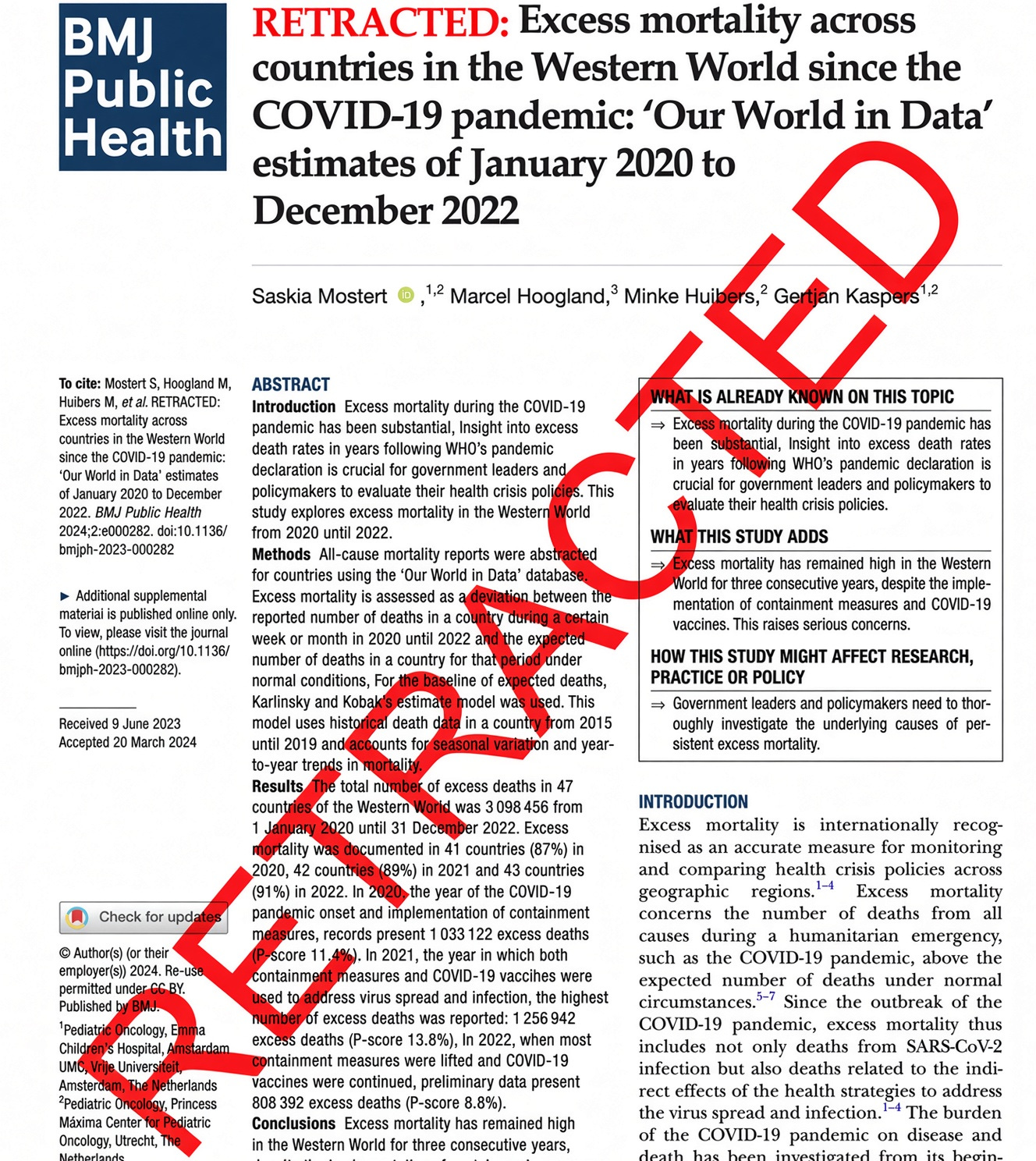
In August 2026, amid fierce controversy, BMJ Group formally retracted a peer-reviewed paper published in BMJ Public Health in June 2024 that documented a staggering three million excess deaths across 47 Western countries between 2020 and 2022. The study, led by Dutch researchers including Dr Saskia Mostert, analysed all-cause mortality data and noted that excess mortality remained elevated for three consecutive years despite containment measures and COVID-19 vaccines. The authors observed that while vaccines were intended to reduce morbidity and mortality, serious adverse events had been reported, and they called for further investigation into the underlying causes of the excess deaths.
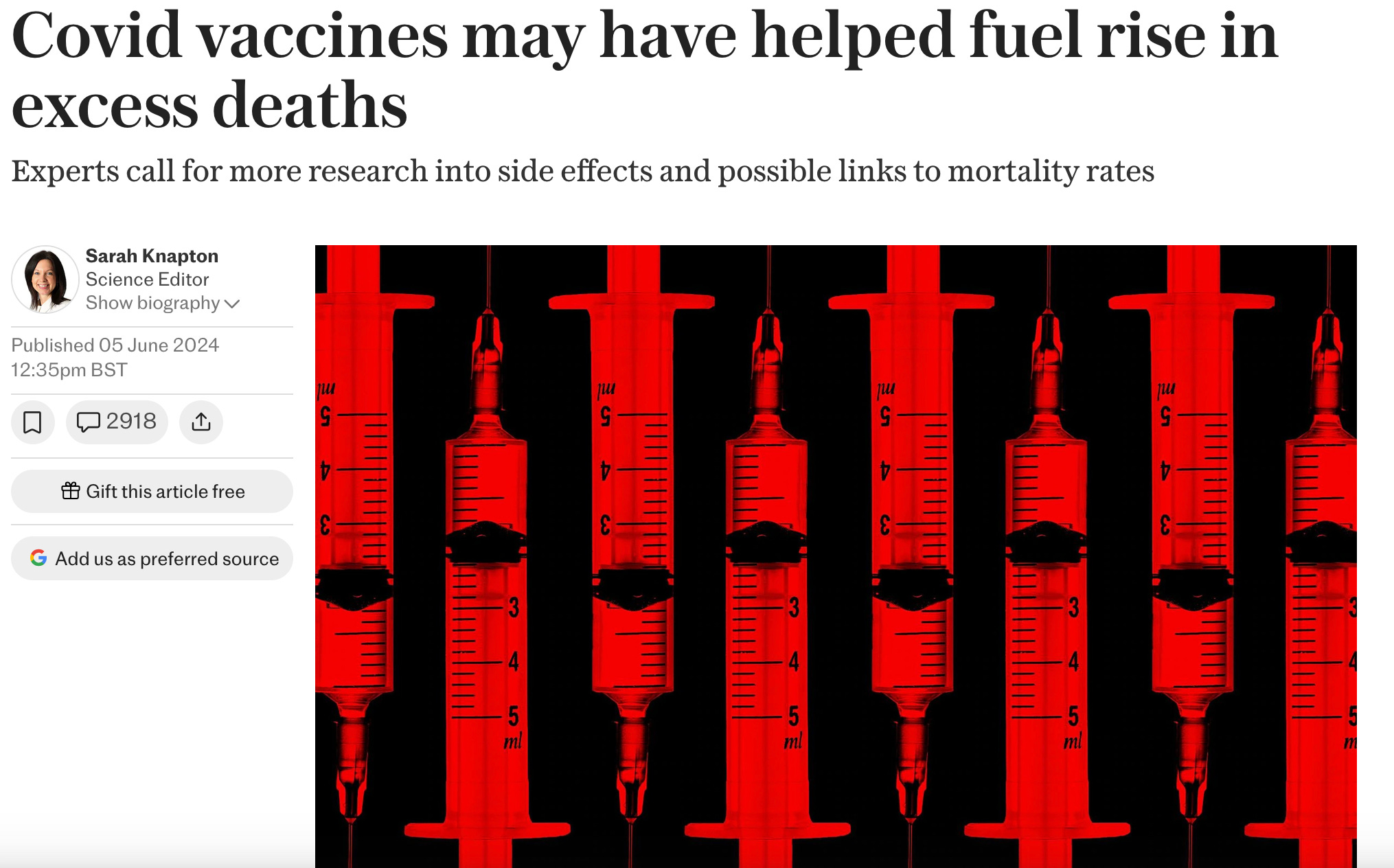
I reported on the pivotal Mostert et al. paper the day after its publication. Its findings attracted widespread media coverage, with The Telegraph daring to write: “Covid vaccines may have helped fuel rise in excess deaths.”
Institutional Distancing
Shortly after publication and amid the media frenzy, the Princess Máxima Centre (where three out of the four authors, including Dr Saskia Mostert, worked at the time of publication) issued a statement on June 11, “distancing itself” from the paper that had undergone nine months of peer review before acceptance.
Their statement, which I included in my follow-up article, has since been removed from their website. It can be read in part below.
“The Princess Máxima Centre distances itself from the publication… Serious questions have arisen regarding the publication… The Princess Máxima Center deeply regrets that this publication may give the impression that the importance of vaccinations is being questioned… We are not experts in epidemiology… We should have been more alert to the formation and results of this publication… We strongly support vaccination, and… this publication should certainly not be read as an argument against vaccination.”
This prompted BMJ Public Health to respond with an “expression of concern” a few days later, on June 14th, clarifying that the study did not establish a causal link between vaccination and deaths.

Official Reasons for Retraction
On 11 August 2026, more than two years after the original expression of concern was issued, BMJ Public Health formally retracted the paper.
The journal stated the decision was based on:
“The article is retracted by the journal for misinformation in the discussion regarding the possible causes of excess mortality, and because the limited nature of the original work by the authors was not sufficiently described.”
Interestingly, an investigation by the Princess Máxima Centre in Utrecht found no evidence of malicious intent, data fabrication, falsification or plagiarism. However, it concluded that the paper paid “disproportionate attention” to the possibility that containment measures and vaccination might have caused excess deaths, was selective in its literature citations, and did not reflect the scientific consensus of the time. Two co-authors (Kaspers and Huibers) supported the retraction on grounds of public misinterpretation risk; the other two, including Mostert, did not.
BMJ Group said it offered the lead author an opportunity to revise the discussion, but judged the proposed changes insufficient. A spokesman emphasised that the retraction was not driven by media coverage of the paper.
It should be noted that under the Committee on Publication Ethics (COPE) guidelines (the international standard followed by BMJ and most major journals), “spreading misinformation” is not, by itself, a recognised or sufficient justification for retracting a scientific paper. COPE requires clear evidence that the findings or conclusions are unreliable due to major error, fabrication, plagiarism, unethical research, compromised peer review, or similar concrete failings. A broad, subjective label such as “misinformation” does not meet this threshold unless it is tied to demonstrable scientific invalidity. Using it as a primary reason, without proving the data or core results are false, is widely regarded as weak justification and has fuelled accusations that the decision went far beyond normal scientific standards.
Criticism of the Decision
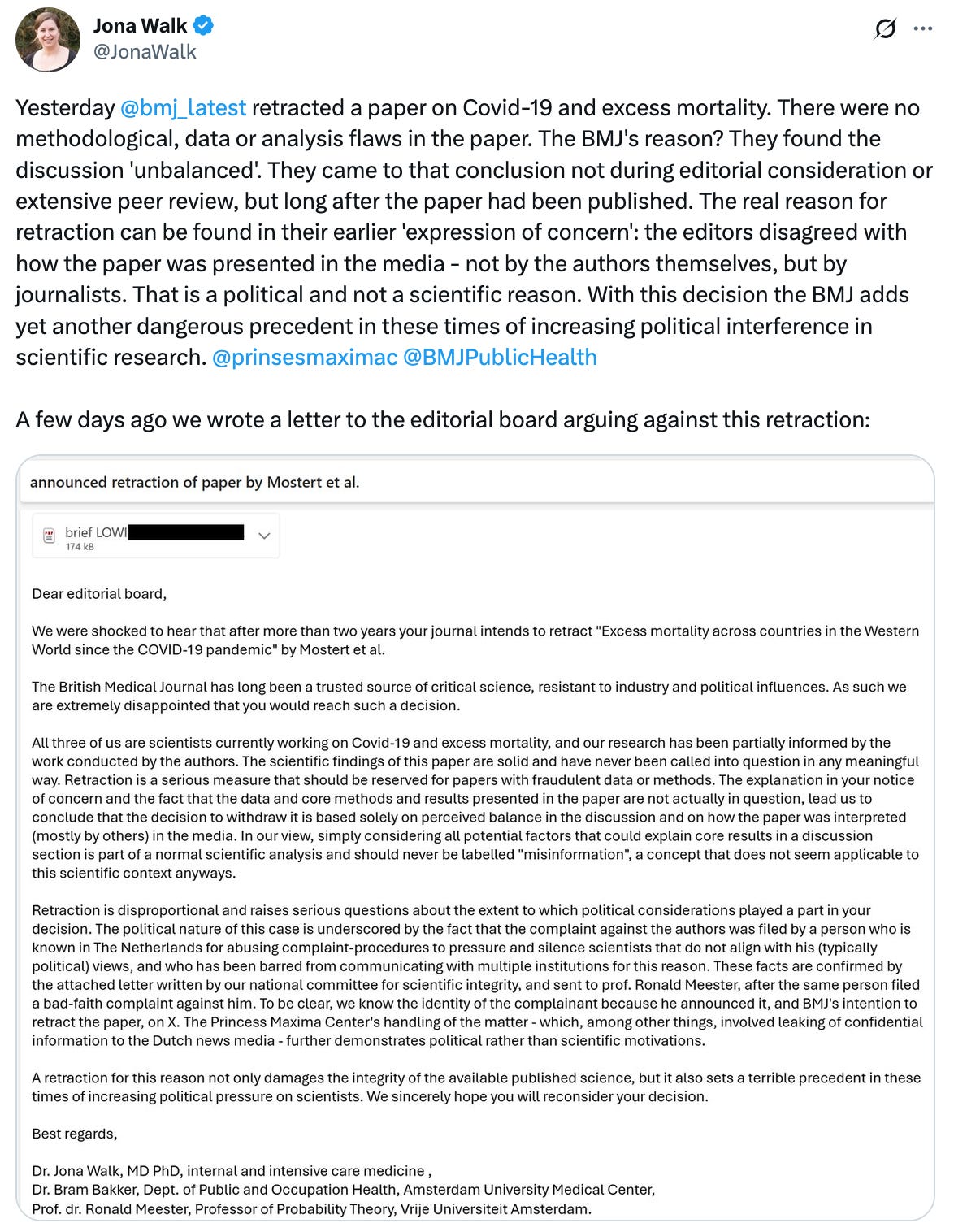
A Telegraph article reported that three Dutch experts wrote to the BMJ editorial board describing the move as “disproportional” and raising “serious questions about the extent to which political considerations played a part.”
Professor Ronald Meester of Vrije Universiteit Amsterdam told The Telegraph there was “no scientific reason to retract” and suggested political pressure may have been involved. Dr Jona Walk, another signatory of the letter, argued on X that the decision was political rather than scientific and set a dangerous precedent amid growing political interference in research.
Lead author Dr Saskia Mostert, who has since resigned from the Princess Máxima Centre, has described the reaction to the paper as “irrational and blind fury.”
In her June 2026 testimony to the US Senate she stated:
“To be clear: I lost my position after publishing official government mortality data and calling for further scientific investigation into persistent excess deaths. Science cannot function when legitimate questions become professionally dangerous to ask. When scientists fear professional destruction, the public loses access to honest scientific inquiry.”
Public Statements by BMJ’s Editor-in-Chief
Kamran Abbasi, Editor-in-Chief of The BMJ, defended the retraction in an X post on 15 August 2026. He described criticism of the decision as “utter garbage and predictable misinformation,” stating that the process was not political, that the journal had not been pressurised by anyone, that the authors had been given a fair hearing, and that the real mistake had been publishing the paper in the first place. Notably, Abbasi chose to share these forthright views on social media while restricting who could reply to his post.

In a follow-up the next day he reiterated that “retracting a flawed paper constitutes scientific integrity.”

Analysis of Scientific Suppression Criteria
Maarten Fornerod, PhD, formerly associate professor at Erasmus MC Rotterdam and author of more than 100 scientific papers, has argued that the retraction of Mostert et al. meets all five criteria for scientific suppression, as identified by Elisha et al. (2024)
According to Fornerod, this pattern strongly suggests suppression rather than a genuine correction of the scientific record. The five criteria, and how they apply in this case according to Fornerod, are:
Timing of actions
The suppressive actions followed soon after newspaper coverage in the UK (The Telegraph) and the Netherlands (de Volkskrant), the latter framing the study as an “anti-vax study.”Unusual venue or source of criticism
Complaints to the host institute originated from a social media figure, Klaas van Dijk, who has a documented history of targeting Covid-critical voices in academia and medicine.Double standard test
Imbalances in academic discussions are common and are sometimes even prompted by peer reviewers. Yet they are almost never (if ever) used as grounds for retraction. Data from Our World in Data is cited thousands of times in scientific literature without similar public complaints about misuse — with the exception of this paper.Vested interests
The host institute (Princess Máxima Centre) has received funding from vaccine manufacturers including Pfizer, and carries reputational interests linked to the Dutch Royal family (whose name it bears). Our World in Data, which also publicly criticised the paper, receives substantial funding from the Bill & Melinda Gates Foundation and the Wellcome Trust via the Global Change Data Lab.Pattern of similar adverse actions
Multiple scientific publications that questioned COVID-19 vaccine safety or efficacy have been retracted in recent years, often without clear adherence to COPE criteria. Examples include Walach et al. (2021), Kostoff et al. (2021), Gautret et al. (2020), Hazan et al. (2022), Rancourt et al. (2021), and Gibo et al. (2024).
Questions of Funding and Institutional Conflicts
It should be noted that BMJ Group has long received substantial revenue from the pharmaceutical and medical-device industries. Its own disclosures show that in the mid-2010s it earned approximately £6.8–7.5 million a year from product advertising, commercial sponsorship and article reprints (representing 8–12% of relevant revenues).
It has also received specific educational grants from Pfizer to fund institutional access to its “Research to Publication” programme. While BMJ maintains that editorial decisions are independent of commercial income, the existence of these long-standing financial relationships raises legitimate questions when the journal retracts a paper that discusses possible harms linked to products made by those same funders.
In the end, a peer-reviewed paper that documented three million excess deaths and merely called for further investigation was erased from the scientific record. Not for fabricated data. Not for plagiarism. Not for methodological fraud. But for the sin of spreading “misinformation.” That single word has now become sufficient grounds to override nine months of peer review, institutional findings of no misconduct, and the core principle that science advances by open debate rather than enforced consensus. When a journal can retract a study because its discussion is deemed insufficiently aligned with the prevailing narrative, the boundary between retraction and censorship collapses.
If this investigative reporting matters to you, please consider a paid subscription or buy me a coffee! Your support makes this work possible.
Thank you Sonia for this excellent summary of the events. Funny how this retraction coincides with the release of Fauci texts. Panic somewhere?
The capture and corruption of our scientific institutions and journals continues!