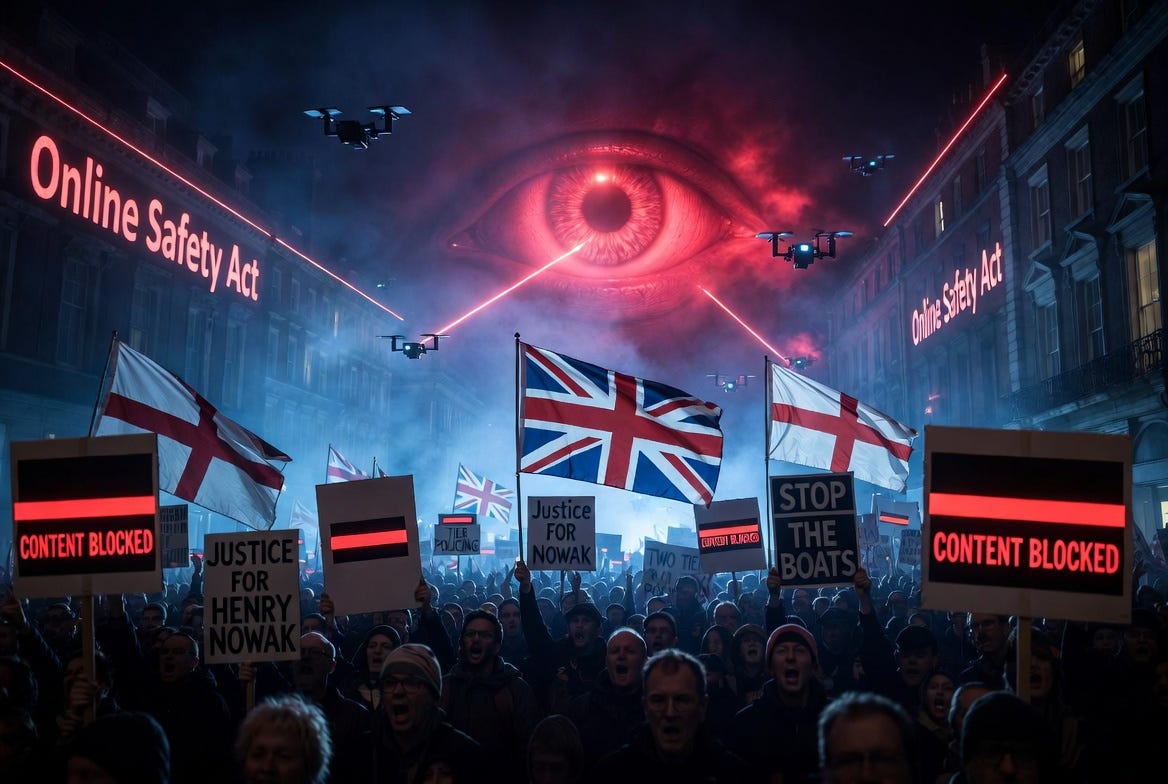
How the Southampton and Belfast Knife Attacks Are Being Weaponised to Accelerate Britain’s Digital Authoritarianism
“Big Brother is watching you.”
With every passing week in 2026 Britain, George Orwell’s warning in 1984 feels less like literary fiction and more like a policy blueprint. Fresh from the ashes of violent unrest in both Southampton and Belfast, the government is rushing through amendments to the Online Safety Act 2023.
What ministers frame as public protection during “times of crisis” is in reality the next phase of a long-planned architecture of surveillance, censorship, and narrative enforcement. One that began its acceleration during the COVID years and shows no signs of slowing.
As an investigative journalist and author of 3/11 Viral Takeover, who has spent years exposing how suppressed science and coordinated censorship shaped the pandemic response, I now see the same machinery repeating itself. What was once used to silence “misinformation” about lockdowns and COVID vaccine harms is now being repurposed for “public order.” The consequences, however, are far more draconian than mere deplatforming or shadow-banning. Dissent on mass immigration or two-tier policing can quickly be labelled “incitement to violence,” declared illegal, and carry potential prison time. Lucy Connolly, for example, was jailed for 31 months in 2024 for a single social media post expressing rage over the Southport attacks and calling for hotels housing asylum seekers to be set on fire.
The Spark: Parallel Knife Attacks in Southampton and Belfast
In Southampton, 18-year-old Henry Nowak was fatally stabbed in December 2025 by Vickrum Digwa. Digwa attacked him with a ceremonial Sikh kirpan, a large dagger he was legally allowed to carry as part of his faith. Digwa falsely claimed that Nowak had racially abused and assaulted him. Despite his desperate pleas of “I’ve been stabbed” and “I can’t breathe,” officers handcuffed and arrested him based on Digwa’s account. Nowak lost consciousness and died at the scene. The release of the shocking bodycam footage in early June 2026 triggered widespread outrage and ignited protests outside Southampton Central Police Station.
Just days later, on 8 June 2026 in north Belfast, 44-year-old Stephen Ogilvie was stabbed in a brutal attack that left him with life-changing injuries, including the loss of an eye. The suspect, 30-year-old Sudanese asylum seeker Hadi Alodid, was charged with attempted murder. Graphic video footage circulated widely, triggering anti-immigration protests that escalated into riots on 9 and 10 June with arson attacks on homes and vehicles, and attacks against police.
Both incidents share common threads: horrific knife violence, rapid online amplification of footage and grievances, and civil unrest framed by authorities as “far-right incitement.”
Within days, Ofcom sent an urgent open letter to online platforms demanding swift removal of “illegal content” that “stir up hatred” and “provoke violence,” in the context of civil unrest in Belfast.
Ministers, including Science and Technology Secretary Liz Kendall, announced plans for secondary legislation to impose crisis protocols on social media firms for faster takedowns during such events.
The Online Safety Act, already one of the most sweeping pieces of digital regulation in the Western world, was always designed with broad, vague duties on platforms to assess and mitigate harms. Illegal content, harmful content to children, and disinformation risks all fall under its scope. The Act’s phased rollout, accelerated after the 2024 Southport riots, gave Ofcom immense power: fines up to 10 percent of global turnover, site blocking, and design mandates that effectively compel pre-emptive censorship.
The twin crises in Southampton and Belfast now provide the perfect pretext to tighten the screws further. Crisis response amendments expected as early as mid-July 2026 will formalise real-time monitoring and removal during periods of rapid unrest. Protest footage, discussions of two-tier policing, immigration statistics shared in anger, or videos challenging official accounts could all be caught in the net of “incitement” or “false information.”
From COVID Censorship to Permanent Control
Since 3/11 (March 11, 2020, the day the WHO declared COVID a pandemic), we have witnessed the birth of a public-private censorship complex: government, Big Tech, NGOs, and fact-checkers working in lockstep to suppress dissenting voices.
The Online Safety Act is the permanent legislative embodiment of that era. Platforms are now required to proactively scan for risks while being forced to balance so-called “democratically important content” against anything authorities deem “harmful.”
Critics ranging from the Free Speech Union to open letters with thousands of signatures have warned that the Act creates over-censorship by design. Vague terms like “harm” invite mission creep. Content about the Southampton protests, Belfast riots, or broader concerns over knife crime, asylum policies, or policing disparities is already being age-restricted or blocked.
Notably, in the hours preceding the Belfast knife attack on 8 June, Prime Minister Keir Starmer announced at London Tech Week that the government would give Apple, Google, and other tech firms a three-month ultimatum (until early September 2026) to implement or activate built-in nudity-detection and blocking features on devices. He warned that if they did not comply voluntarily, the government would introduce new legislation to force it.
In response, Signal, the encrypted messaging service known for its uncompromising stance on privacy, issued a powerful warning in its statement “Surveillance Is Not Safety,” shown below.
The organisation slammed government demands for age verification combined with content scanning on devices as a “dystopian” measure that “will not safeguard children. It endangers us all.”
Signal emphasised that such tools, once created, inevitably expand beyond their stated purpose: “mass surveillance and censorship capabilities, however sincere-sounding the promises... never remain narrowly scoped.” They warned of on-device scanning evolving into broader political surveillance and automatic reporting to authorities.
The Broader Dystopian Picture
As noted earlier, the censorship industrial complex that profited from COVID-era controls has found new life in public order pretexts. Tommy Robinson speaking at protests, protest videos going viral, or discussions of immigration and crime statistics all become ripe for “the far-right” disinformation label that justifies intervention.
As Big Brother tightens its grip on online speech, the real drivers of unrest: the profound failures of uncontrolled mass immigration, the buried grooming scandals, and systemic two-tier policing, are being pushed further into the shadows. In the end, it is easier for authorities to silence the messengers than to confront the uncomfortable truth.
If this investigative reporting matters to you, please support independent journalism with a paid subscription or buy me a coffee!
Buy your copy of 3/11 Viral Takeover (available in Kindle eBook, paperback, and hardcover) here:


I am so very glad that I don’t live in the UK. I worked in Southampton as a US government contractor on and off from 2001 to 2005 and spent two complete summers there in support of that project. I loved the people and I loved the countryside, but even then the nanny state was more than I could stomach. Sadly the US is walking down the same path. Once I saw the propaganda games played by our government during COVID, I can no longer un-see it in its other manifestations (e.g., hurricane fear porn — I live in Florida, monkey pox, bird flu, Ebola, ticks, etc.). But seeing it allows me to evade the trap. So I guess there is some consolation.