



A newly disclosed cache of Health Canada documents, forced into the open by Canada’s Information Commissioner in June 2026, confirms what independent researchers have been documenting for years. The agency identified “unnecessary” SV40 promoter and poly-A terminator sequences in the plasmid backbone used to manufacture Pfizer-BioNTech’s COMIRNATY shots. Health Canada strongly recommended their removal but Pfizer refused. An SV40 promoter sequence used in gene delivery because it can help DNA reach the nucleus, packaged in lipid nanoparticles, is a cancer-relevant risk the public was never told about. To this day, plasmid-derived DNA elements remain in COMIRNATY.
The documents, first highlighted recently by researcher Scoops McGoo, include a Health Canada quality review summary and internal emails from August 2023.

They are the result of an access-to-information request specifically seeking records mentioning Simian Virus 40 (SV40) in relation to COVID-19 vaccines.
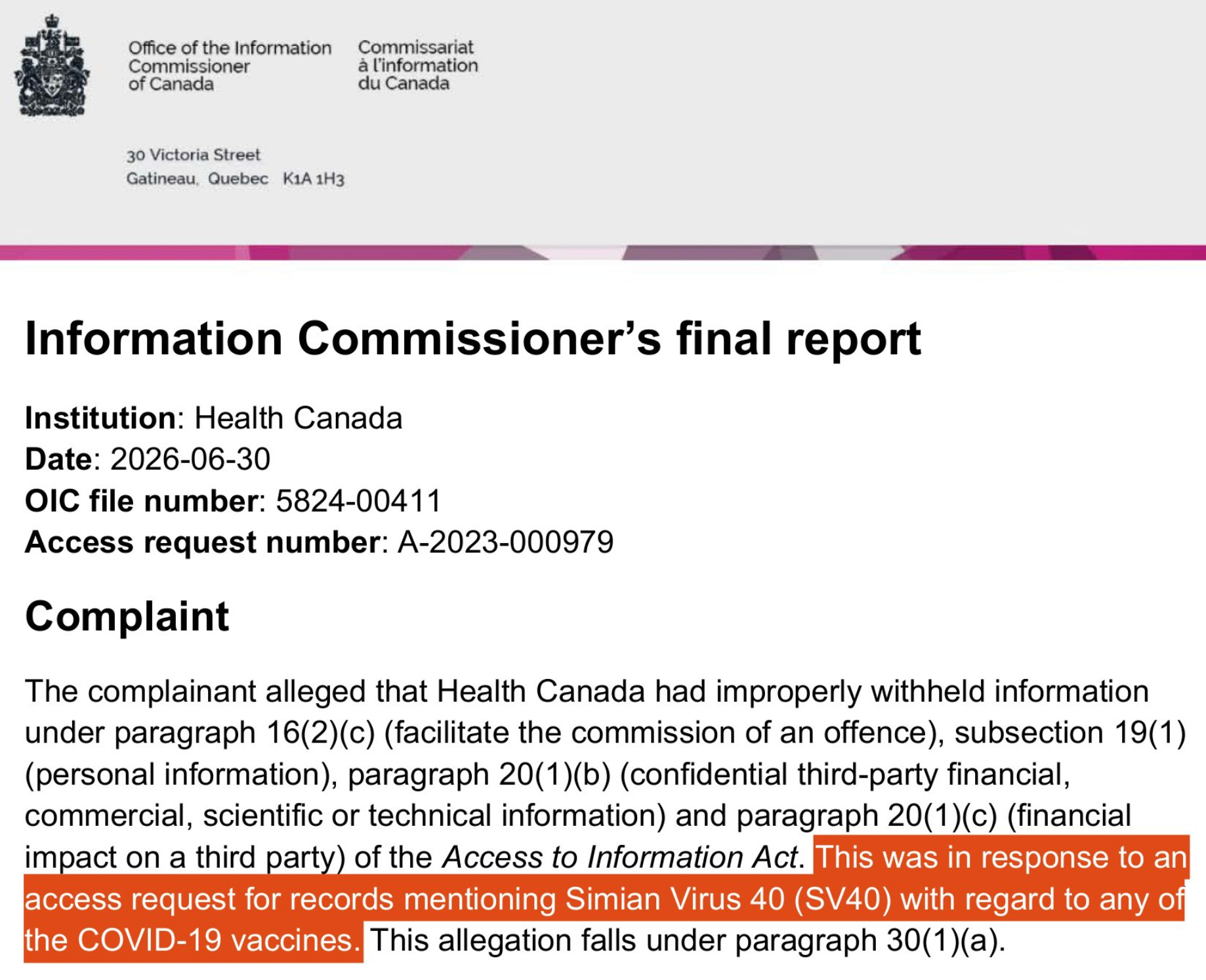
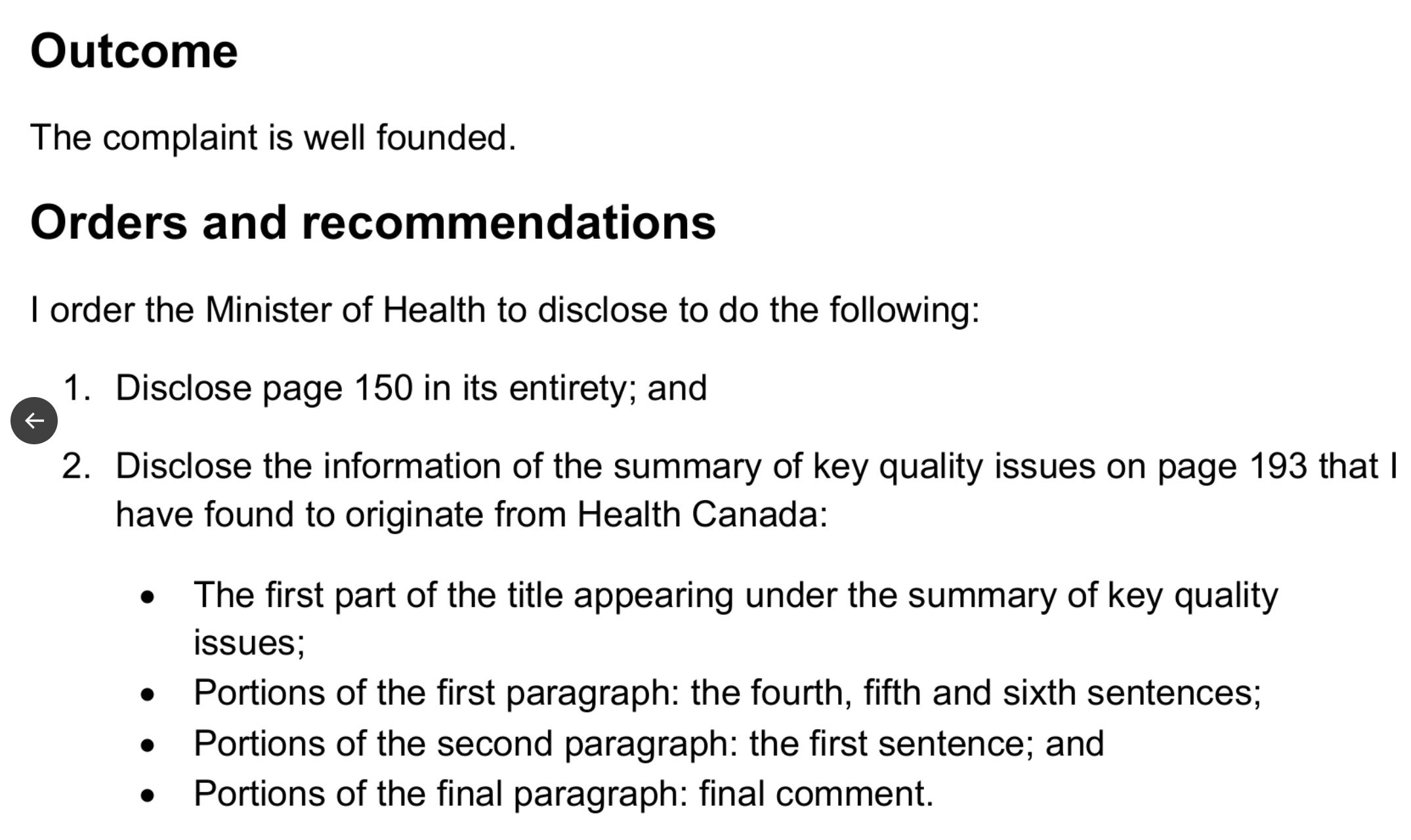
After Health Canada withheld material, the Information Commissioner ruled the complaint “well-founded” and ordered further disclosure of pages 150 and 193 of the relevant file. The official finding is damning: a national regulator withheld records about residual SV40 promoter sequences in a product rolled out to the public.
What the quality review actually said
Under the heading “SUMMARY OF KEY QUALITY ISSUES,” Health Canada reviewers addressed “Unnecessary regulatory elements present on plasmid.”
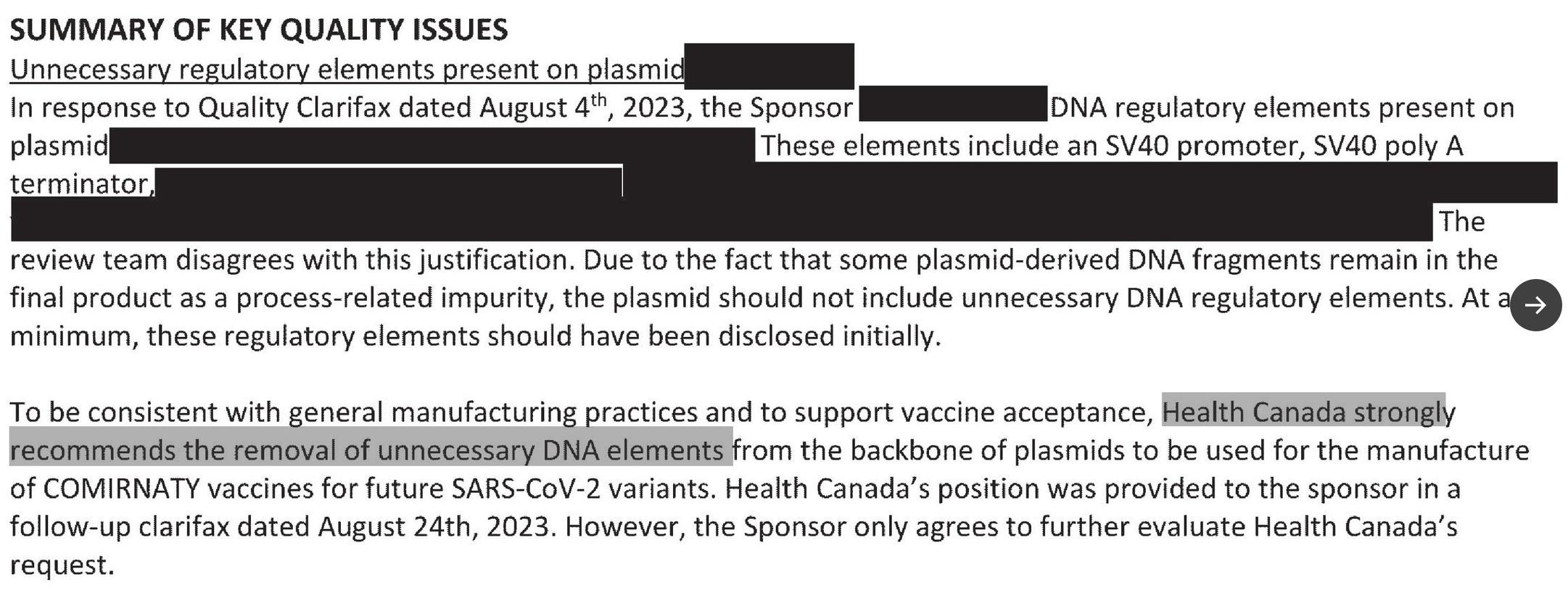
They noted that, in response to a Quality Clarifax dated 4 August 2023, the sponsor (Pfizer) had acknowledged DNA regulatory elements on the plasmid. These included an SV40 promoter and SV40 poly-A terminator.
The review team rejected Pfizer’s justification for it because plasmid-derived DNA fragments remain in the finished product as a process-related impurity, “the plasmid should not include unnecessary DNA regulatory elements. At a minimum, these regulatory elements should have been disclosed initially.”
The document then states, in language that leaves little room for interpretation:
“To be consistent with general manufacturing practices and to support vaccine acceptance, Health Canada strongly recommends the removal of unnecessary DNA elements from the backbone of plasmids to be used for the manufacture of COMIRNATY vaccines for future SARS-CoV-2 variants.”
Health Canada communicated this position in a follow-up clarifax to the sponsor on 24 August 2023. Pfizer responded by only agreeing to “further evaluate” the regulator’s request. In other words, the pharmaceutical company had no intention of doing anything about it.
Where the SV40 DNA actually came from
Japanese patent attorney “Patent SUN” has traced Pfizer’s manufacturing plasmid to a 1990s research kit, pCMV-Script, sold “for research use only.” Mainz scientists who built BioNTech’s pST platform wrote that they engineered pST1 from that vector. The SV40 sequence sits in that inherited backbone. The European Medicines Agency’s Rolling Review names BioNTech’s production plasmid and prints a map that labels T7, spike, poly-A and the resistance gene. Notably, the SV40 element is not marked (see plasmid map below).

What is missing, Patent SUN noted on X, is not a generic SV40 label. It is DNA from pCMV-Script, a Stratagene/Agilent reagent sold for research, not for pharmaceutical or clinical use. Given the history BioNTech itself published, Patent SUN wrote, “all of this should have been submitted from the outset.”
This is what Health Canada’s “should have been disclosed initially” was pointing at. The SV40 sequences were inherited, left off the public plasmid map but left on the licensed backbone, even after the regulator asked them off.
Health Canada’s email chain the next morning
An email chain dated 25 August 2023 (the day after the clarifax was sent) captures the regulators’ reaction to Pfizer’s response.
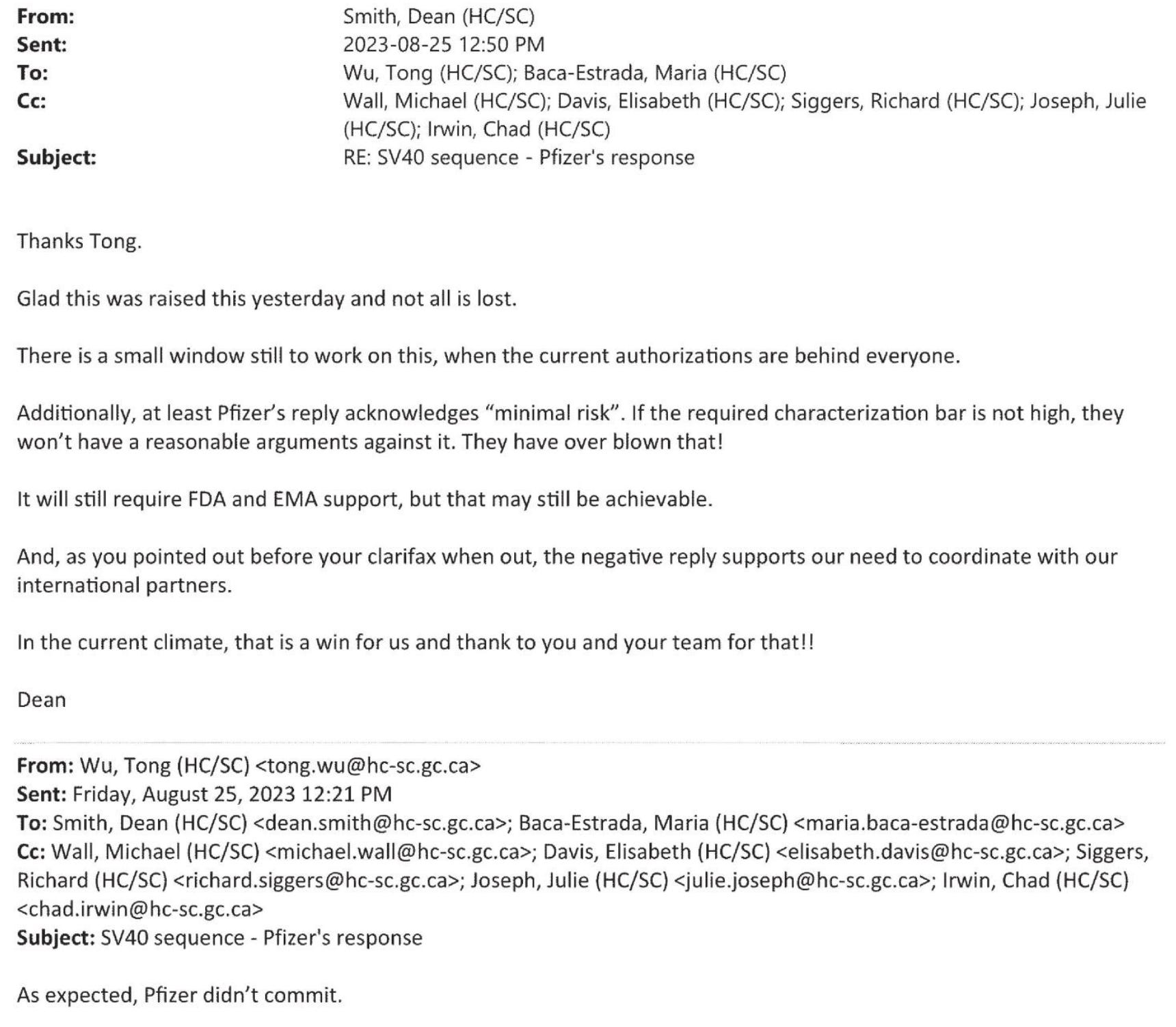
These emails show Canadian officials knew the sequences were unnecessary and wanted them gone. Wu’s “As expected, Pfizer didn’t commit” means they also knew the sponsor would hide behind “minimal risk.” The fact Dean Smith writes, “They have over blown that!” is evidence that a Health Canada official strongly believed Pfizer’s risk assessment was overstated and that if the regulator and its allies set a higher “characterisation bar” (more data on what the fragments actually are and do), Pfizer would no longer have a “reasonable argument” for leaving the sequences on the plasmid. The paper trail and a reason to internationalise the fight, is what he called “a win.” However, international pressure from the regulators never materialised.
What independent researchers have been documenting since 2023
In April 2023, Kevin McKernan and colleagues sequenced expired bivalent Pfizer and Moderna vials and reported leftover expression-vector DNA in both, at levels they put in the nanogram-to-microgram range per dose. The abstract says multiple assays supported DNA above the EMA 330 ng/mg and FDA 10 ng/dose figures. Pfizer vials also carried the SV40 promoter/enhancer from the manufacturing plasmid. Following this discovery, I wrote a two-part investigation, “Thou Shalt Not Adulterate” on residual plasmid DNA and the SV40 sequences in the mRNA shots.
In addition, independent laboratories, in different countries, with different methods have found these findings repeatedly.
Professor of Cancer Molecular Genetics Phillip Buckhaults PhD told the South Carolina Senate he had confirmed plasmid DNA, including SV40 sequences, in the Pfizer shots.
In Germany, Ulrike Kämmerer and Klaus Steger reported large amounts of residual DNA in BioNTech lots, including SV40 promoter/enhancer and the antibiotic-resistance gene after RNase A treatment, with fluorometry readings they put above the 10 ng/dose cap.
In Canada, David Speicher et al., tested tracked Canadian vials. Their work first appeared as a 2023 preprint and was later published in Autoimmunity (2025). The researchers found residual plasmid DNA in both products. SV40 promoter-enhancer-ori was detected only in Pfizer vials. Depending on the assay (qPCR on specific plasmid targets versus fluorometry for total DNA), some readings exceed the 10 ng-per-dose residual-DNA limit written for older biologics. Notably, this limit was never designed for nucleic acids that lipid nanoparticles protect and help deliver into cells.
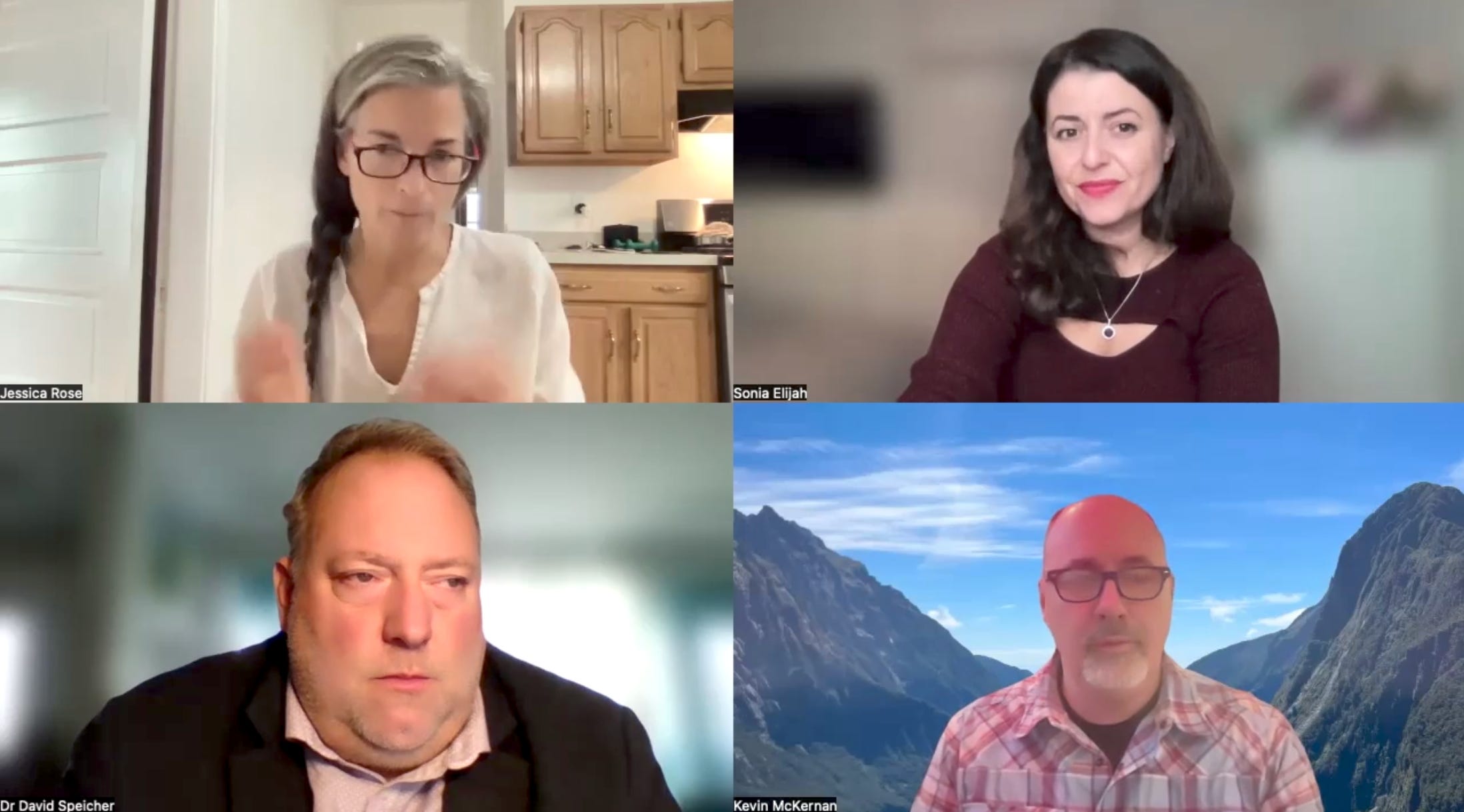
I later sat down with David Speicher, Kevin McKernan and Jessica Rose on the measurements, the assays regulators prefer, and why a 10 ng-per-dose cap written for older biologics does not fit DNA that is wrapped in lipid nanoparticles. The conversation also covered the campaign against their paper: the retraction pressure and the wider attempt to shut the work down.
The DNA contamination scandal is also forensically documented in Chapter 12 of 3/11 Viral Takeover.
What Parliament asked and what Ottawa read out instead
On 2 May 2024, MP Dean Allison put Question No. 2665 on the Order Paper. The question was built from emails the House already knew existed: August 2023 emails among Health Canada (HC), EMA and FDA before a meeting on 24 August 2023 (the same day HC sent Pfizer the follow-up clarifax), HC scientist Michael Wall’s note five days later, plus an EMA officer writing to Dr. Dean Smith on 12 October 2023.
Allison asked, in substance: What did Health Canada actually fear in those August 2023 emails with EMA and FDA and what did it ask Pfizer? Had its scientists read McKernan? Did it still claim no peer-reviewed paper showed a human risk from the enhancer? Did it know the SV40 promoter-enhancer can bind p53 (Drayman) and can act as a nuclear targeting sequence (Dean, 1999) and was either risk put to Pfizer? If the sequences were expected and safe, why did Michael Wall write on 29 August 2023 that Canada would work with partners to remove those elements from the plasmid at future strain changes? What action followed EMA’s 12 October note to Smith on SV40 and “alleged high level of DNA”? What assessment said the enhancer was safe inside an LNP product and what is the policy for any vaccine?
On 19 June 2024, Yasir Naqvi, Parliamentary Secretary to the Minister of Health, delivered the government’s reply. It read like a press statement.
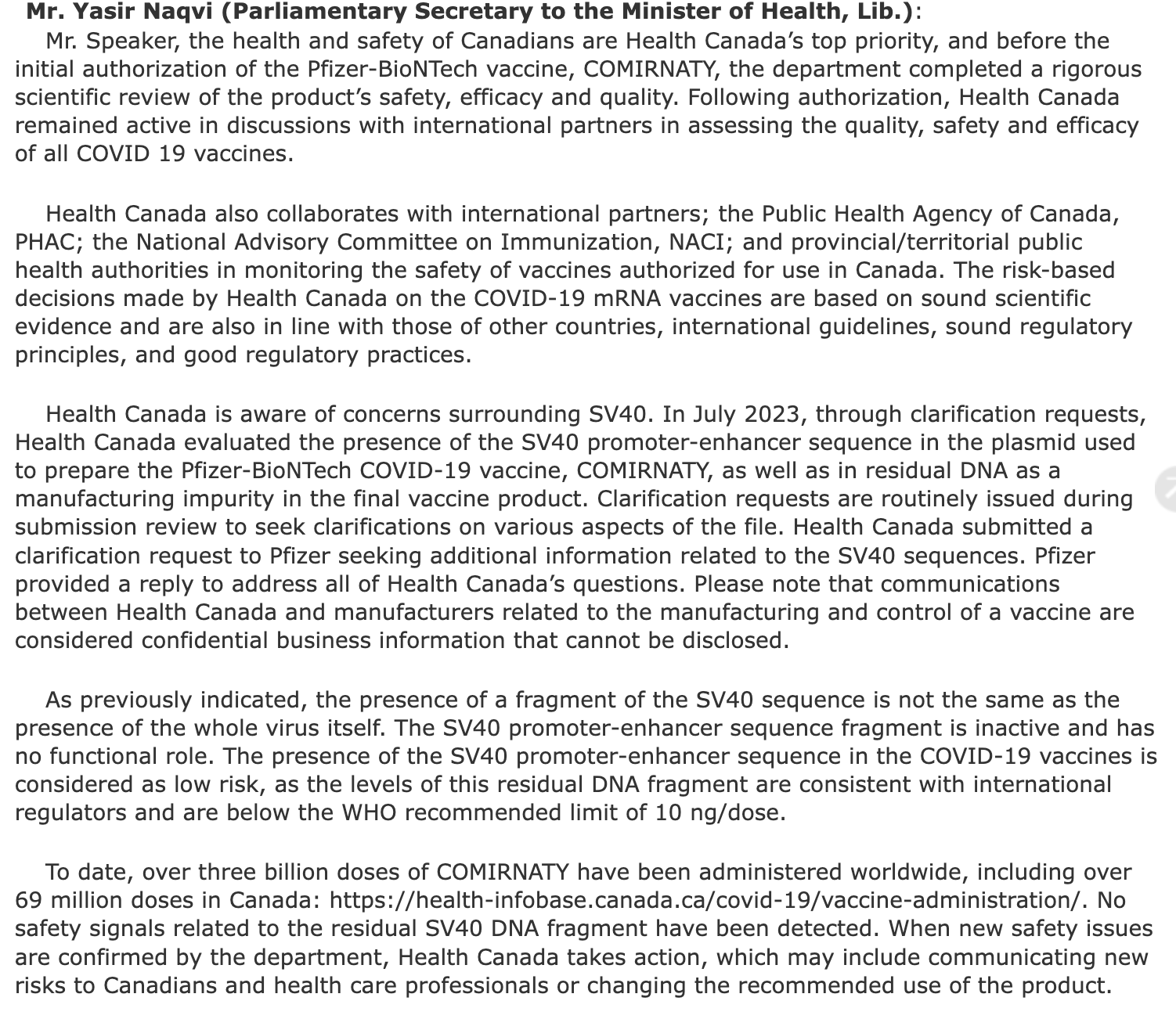
Rather than answering Allison’s questions, the government chose obfuscation. It said Pfizer had replied “to address all of Health Canada’s questions,” but those communications could not be disclosed because they were “considered confidential business information.” It also said the residual SV40 DNA fragments are “considered as low risk.” Notably, this was an echo of the sponsor’s line evidenced in Dean Smith’s email sent to his colleagues a year earlier.
What Health Canada told the public
In October 2023 Health Canada confirmed an SV40 promoter-enhancer in Pfizer-BioNTech’s COVID shot after McKernan and Buckhaults made it public. The agency told the Epoch Times it expects sponsors to flag “biologically functional” plasmid sequences such as an SV40 enhancer at filing but Pfizer’s full plasmid sequence did not specifically identify SV40. The EMA and FDA later also acknowledged the sequence.
Health Canada went on to say: cancer-link claims are “unfounded”; the fragment is “inactive, has no functional role, and was measured to be consistently below the limit.” When the Epoch Times asked for the risk assessment, the studies behind that claim, what “inactive” means in a human cell, why the sequence is there if it has no role, and the actual SV40 measurements and methods, Health Canada would not provide them.
The newly released review and emails reveal that the agency itself called the elements “unnecessary,” said they should have been disclosed at the outset, and strongly recommended their removal from plasmids used for future COMIRNATY variants.
If the fragments were truly nothing, there was no reason to “strongly recommend” their removal. If removal was the right manufacturing practice, there was no excuse for leaving them in or for telling the public they did not matter.
Pfizer did not remove them. The regulators did nothing about it. The public was told none of this and went on receiving an adulterated gene-based product.
If this investigative reporting matters to you, please consider a paid subscription or buy me a coffee! Your support makes this work possible.
Wow! I read your superb book, 3/11 viral takeover; if the 2015 Moderna mRNA patent had the Furin cleavage, why should be be surprised it also had SV40 enhancer and promoter sequences? You description of the “bait and switch” operations that allowed Pfizer to use high purity mRNA for animals trials and dirty E.Coli plasmids for human jabs, should tell us why the Covid shots killed 1.1 million people with plasmid DNA contamination 500-800 times over 10ng limits plus endotoxins. Military grade SV40 is available to these jab shot manufacturers, is it also aerosolized? Remember the military grade anthrax after 9/11 custom delivered in envelopes? It gives a whole new meaning to contrails!