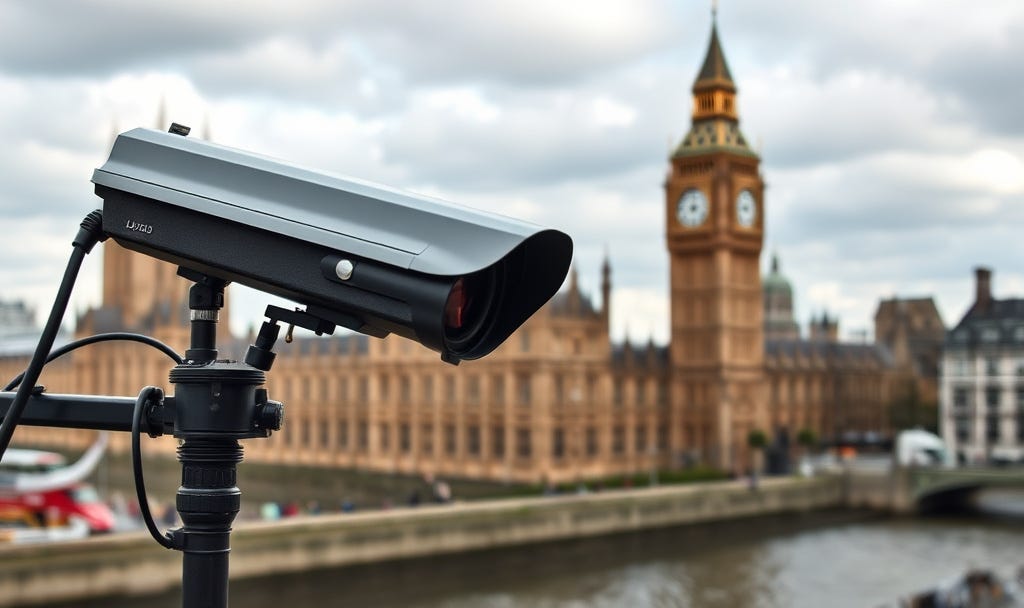
Britain’s March Towards a Spy State
The rapid rise of AI-powered mass surveillance is one of the biggest threats to our personal freedoms right now. What started as tools for catching specific criminals has exploded into huge systems that watch and predict what billions of people are doing, all in real time, often without proper checks or our consent. Governments and corporations deploy these technologies under the banner of “safety,” yet they deeply erode privacy and free expression.
China: The Global Benchmark for Digital Control
The country has around 700 million surveillance cameras, that’s more than one for every two people. Programs like “Sharp Eyes” and “Skynet” use AI to recognise faces, analyse how people walk, identify voices, and even predict behaviour. It all links up into one massive system for controlling the population. In the Xinjiang region, AI flags Uyghur Muslims for everyday things like praying or posting on social media, feeding them into vast networks of detention camps where over a million have been held, often without trial. Now, advanced AI even handles censorship, directs police, and watches prisoners’ emotions in high-tech jails. This is pre-emptive governance: dissent is anticipated and crushed.
Exporting the Model: From Lockdowns to Surveillance Tech
Just as China pushed its strict “zero-COVID” lockdowns around the world during the pandemic with quarantines, mass testing, and shutdowns that many nations copied, the country is now aggressively selling its AI surveillance tech. Chinese companies such as Huawei, Hikvision, Dahua, and ZTE are supplying “safe city” and “smart policing” kits to dozens of nations. These include facial recognition cameras, AI analysis tools, and systems that combine data just like back home in China.
China is beating the US in deals for this facial recognition gear. At least 63 countries have taken it up, especially in Africa, Latin America, and Asia, often funded through China’s huge Belt and Road projects. Huawei has set up nationwide systems in places like Uganda and helped Zimbabwe monitor its people (where one firm even tested its tech on locals). In Mexico and Peru, cities use Dahua and Hikvision cameras. In Malaysia and Pakistan, they’re building “digital twin” cities for constant tracking. China even runs training sessions and seminars to promote its approach.
The West is Heading Towards Digital Control
In my book 3/11 Viral Takeover, I warn about the West’s descent into digital authoritarianism, sparked from the fallout following the World Health Organization’s declaration of the COVID-19 pandemic on March 11, 2020, which I mark as 3/11.
The UK is a prime example of a democracy rushing headlong into this. Facial recognition, AI that spots unusual behaviour in videos, and scraping social media posts are already letting police profile people in real time on a massive scale. An extract from the book reads, “In 2025, trials in cities like London have integrated AI cameras that scan crowds in real-time, linking to national databases for instant identification, a capability that has moved from pilot to operational use in 2026, evoking a biometric police state.”
UK police are massively expanding live facial recognition (LFR). The fleet of mobile vans with this tech is set to jump from around 10 to over 50, ready for use in town centres, crime hotspots, and transport hubs. The Metropolitan Police has scanned millions of faces recently, leading to hundreds of arrests. Permanent setups are running in places like Croydon and major train stations.
Home Secretary Shabana Mahmood is pushing hard for AI to “get ahead of criminals,” even referencing the old idea of a “panopticon,” a prison where inmates feel watched all the time. A national facial matching service is in the works, and there’s a fresh consultation launched in March 2026 on voluntary national digital IDs for public services. Critics fear this could open the door to much wider tracking and data merging. Civil liberties campaigners say it’s risking permanent mass surveillance, eroding the idea that you’re innocent until proven guilty, boosting chances of wrong identifications, and leaving protections worryingly thin.
In the United States: Growing Federal Use and Big Ethical Rows
Across the pond, US agencies like Homeland Security, ICE, and the FBI are ramping up AI for matching biometrics, tracking vehicles, and analysing social media. Private firms scan millions of posts, and old laws let them access commercial data without warrants. Civil liberties groups warn of a creeping digital police state where biased AI automates and muzzles critics.
Tensions boiled over in early 2026. AI firm Anthropic turned down Pentagon contracts over worries about mass domestic surveillance and killer robots without human control, leading the Defence Department to call it a “supply chain risk” and block it. Rival OpenAI stepped in, agreeing in February 2026 to put its models on classified military networks (with some limits in the contract, though critics say they’re too vague). Then, on March 7, 2026, OpenAI’s head of hardware and robotics, Caitlin Kalinowski, quit in protest. She said: “Surveillance of Americans without judicial oversight and lethal autonomy without human authorisation are lines that deserved more deliberation than they got.”
“Big Brother is Watching You”
The danger is real: AI takes everyday data like phone locations, web browsing, and who you know, then builds detailed predictions of your behaviour on a huge scale. These systems can crush dissent and make constant monitoring feel normal. China’s dual export of harsh lockdowns, then its surveillance tech, looks like the clearest roadmap to an Orwellian future where “Big Brother is watching you.”
The big question isn’t whether this is coming but whether we act before it becomes our reality.
If you appreciate the work I do as an investigative journalist, please consider supporting me with a paid subscription or buy me a coffee!


The nanny state mantra here in the US has changed from “It’s for the children” to “It’s for our safety.” I’m sure George III’s general warrants were also just “for our safety.” We need to change our thinking. And that begins by recognizing the faulty thinking that is already ingrained in us. Thank you for your reality checks.